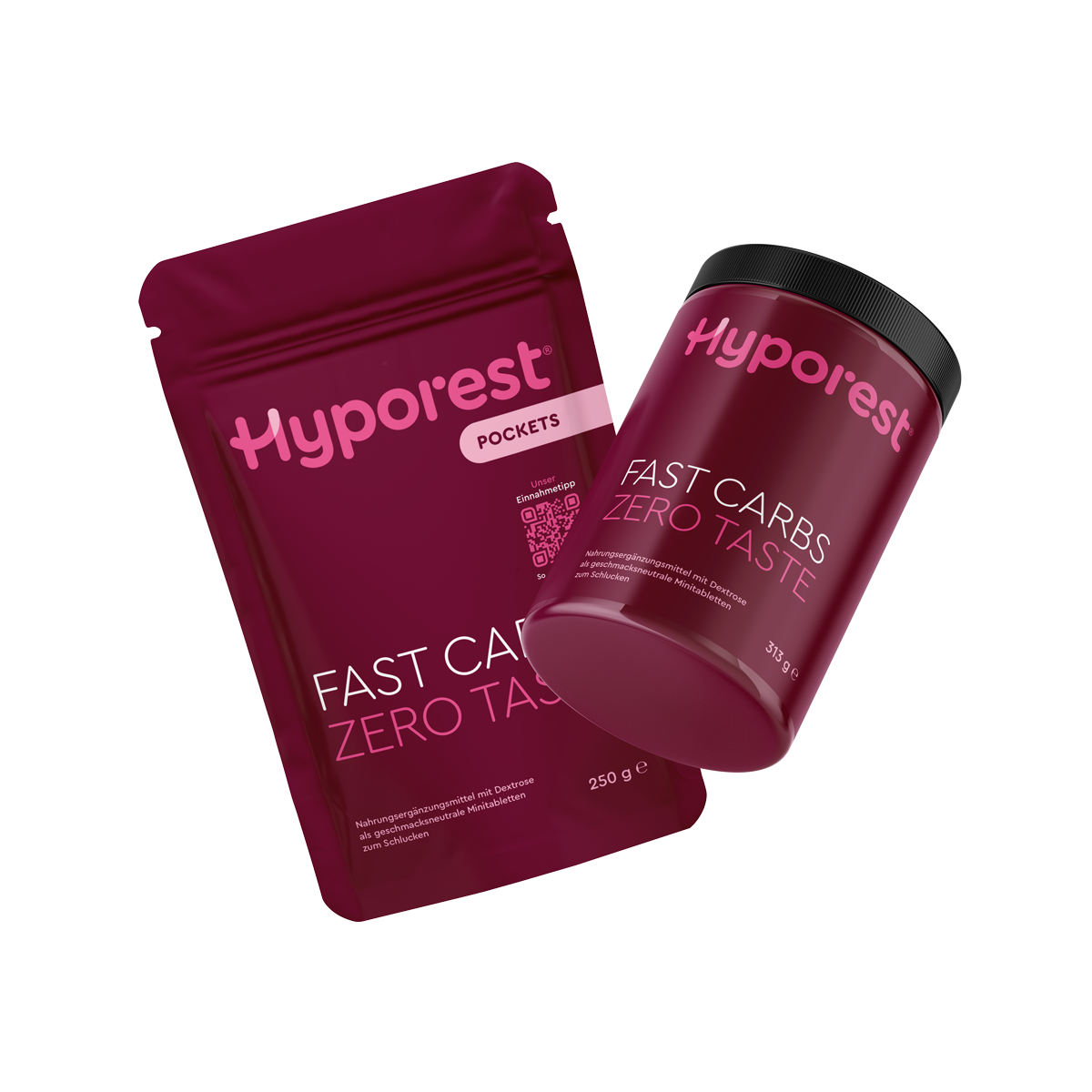
Dextrose, commonly known as glucose, is the crystalline form of Glucose. Chemically it is a Monosaccharide (Simple sugar) with the molecular formula C₆H₁₂O₆. Glucose plays a central role in human energy metabolism.
Chemical classification and properties
| feature | Description |
|---|---|
| Chemical name | Glucose/dextrose |
| class | Monosaccharide (simple sugar) |
| Molecular formula | C₆H₁₂O₆ |
| Primary function | Central energy source in metabolism |
| Storage form | Glycogen (in liver and muscles) |
Physiological significance
- Energy supply: Glucose is an important source of energy for body cells.
- Storage: Excess glucose is called Glycogen stored in the liver and muscles.
- Own production: The body can produce glucose itself when needed.
- Availability: As a simple sugar, glucose is available to the body without prior breakdown.
Effect in the organism
- Absorption: Absorbed into the bloodstream via the small intestine.
- Blood glucose level: Increase in glucose concentration in the blood.
- Energy production: Used by body cells to generate energy.
- Storage: Conversion of unnecessary amounts into glycogen.
Comparison with other types of sugar
| type of sugar | Structure | Classification |
|---|---|---|
| Dextrose | Simple sugars | Available directly |
| Sucrose | Disaccharide (glucose + fructose) | Prior split required |
| Maltodextrin | Glucose chains | Multi-stage dismantling |
| Strength | Polysaccharide | Complex degradation process |
Application context
- Sports: Use as an ingredient in carbohydrate-containing drinks.
- Diabetes context: Related to Hypoglycemia is often called glucose.
- Food industry: Used in beverages, baked goods and confectionery.
- Legal status: Classified as a food ingredient in the EU.
Further topics:
- dextrose and insulin
- How quickly does dextrose work?
- Knowledge about dextrose (overview)
- Why hyporest
Scientific evidence & sources
- Berg JM, Tymoczko JL, Stryer L. Biochemistry [Internet]. 7th ed. New York: W H Freeman; 2012. Section 16.1, Glycolysis Is an Energy-Conversion Pathway. Available at: https://www.ncbi.nlm.nih.gov/books/NBK22593/
- Löffler G, Petrides PE, Heinrich PC. Biochemistry and pathobiochemistry [Internet]. 9th edition Berlin, Heidelberg: Springer; 2014. Available at: https://link.springer.com/book/10.1007/978-3-642-17972-3
- Burke LM, Hawley JA, Wong SH, Jeukendrup AE. Carbohydrates for training and competition. J Sports Sci [Internet]. 2011;29(Suppl 1):S17–27. Available at: https://pubmed.ncbi.nlm.nih.gov/21660838/
- Holesh JE, Aslam S, Martin A. Physiology, Carbohydrates [Internet]. Treasure Island (FL): StatPearls Publishing; 2023. Available at: https://www.ncbi.nlm.nih.gov/books/NBK459280/
Important note:
The information in this encyclopedia article is intended solely for general and non-binding information. They do not replace medical advice, diagnosis or therapy. If you have any health questions or complaints, please always consult a doctor or qualified healthcare professional. The content was created with the greatest possible care, but errors cannot be completely ruled out.
Last updated: February 26, 2026