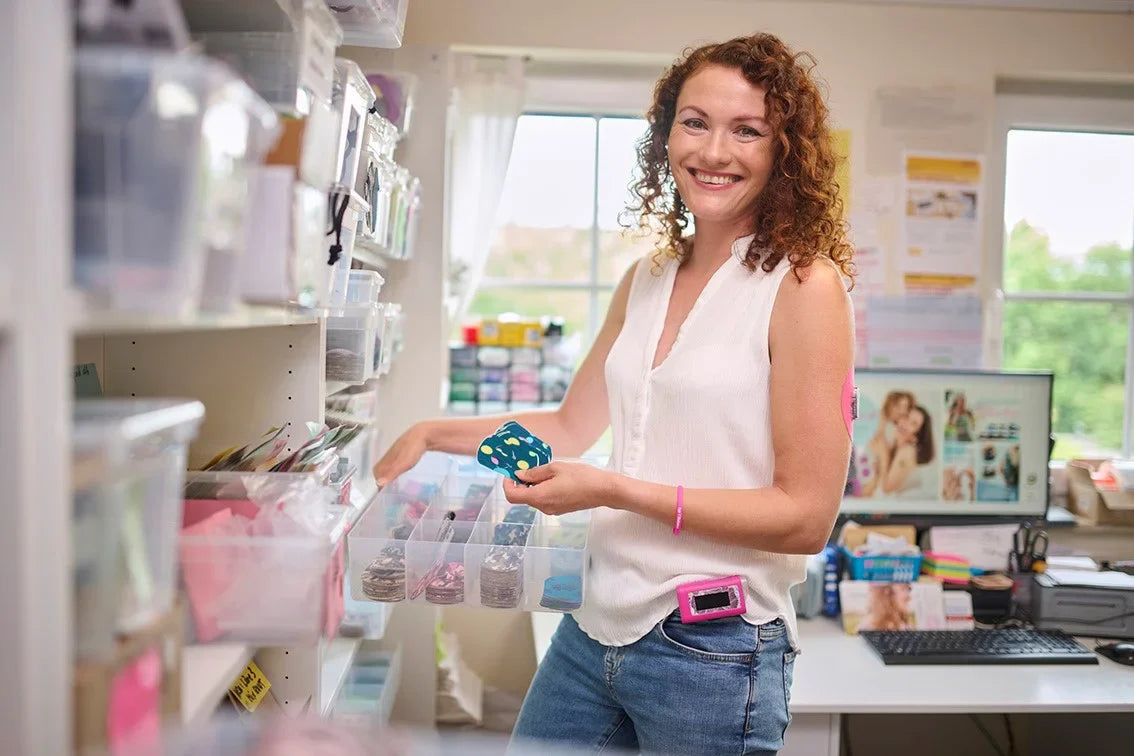
For years, Sonja Spörlein preferred to keep her diabetes hidden from others. Today, the 45-year-old founder from Küps in Upper Franconia wears her sensor openly on her upper arm, often with a sticker she designed herself. She was diagnosed with type 1 diabetes at age seven, and for a long time, her pump and sensor were among the things she would have preferred to keep hidden. But one day, she decided to channel the energy she’d long spent hiding into the opposite: true to her life motto, “When life gives you a lemon, ask for salt and tequila!” she turned her fighting spirit outward. Driven by this energy, she founded Zuckerschmuck in 2015—Germany’s first online shop for diabetes stickers—which now offers a vast selection of products for everyday life with diabetes. Today, more than 40,000 people with diabetes turn to her for stickers and tapes for their sensors and pumps, skin protection, fanny packs, jewelry, and innovative solutions like hyporest.com" title="Hyporest Homepage">Hyporest. Sonja’s designs are now in demand internationally. We spoke with her about the game of hide-and-seek, the turning point, and a healthy dose of defiance.
Sonja, let’s start at the beginning. When were you first diagnosed with diabetes?
Sonja: “I was diagnosed with type 1 diabetes when I was seven. So I don’t really know what life is like without diabetes. But at home, the disease was never the center of attention, which—looking back—I consider a great blessing: I was able to play sports, try everything, grow up just like anyone else—no one wrapped me in cotton wool. That sense of normalcy was a gift. As a child, I learned that diabetes is part of who I am, but it doesn’t define who I am or what I can do. I think that mindset is why I later wanted to actively make the most of it, rather than just manage it.”
How did you cope with diabetes as a child and teenager?
Sonja: “To be honest, for a long time I preferred to hide it. I’ve always been the kind of person who wanted to take matters into my own hands. Sensors and insulin pumps didn’t exist back then. I was on an intensive insulin regimen with fixed mealtimes, fixed doses, and a strict ban on eating sweets. Yes, that’s how strict it was ‘back then.’ I checked my blood sugar and gave myself injections in secret, whenever possible where no one was watching. I simply wanted to spare myself the same old questions from classmates who didn’t know what type 1 meant. I’d rather stay invisible, I thought to myself.”
Was there a time when it got really hard?
Sonja: “At 18, yes. My numbers just wouldn’t cooperate, no matter how hard I tried. My long-term blood sugar level, the HbA1c, kept coming in at around 8.0, well above what I wanted to achieve. My doctor at the time brushed it off rather matter-of-factly and ultimately blamed it on my lifestyle. That hurt. You’re trying your best, following all the rules, and yet you’re told the problem is you. Especially as a young woman just starting out in adulthood, that’s a bitter message. That experience showed me how much depends on whether someone really takes you seriously.”
What was the turning point?
Sonja: “Switching to a different diabetes clinic. My new doctor switched me to insulin pump therapy and really took the time to work with me to find the right basal rate. Suddenly, my numbers were right, and I could finally eat more flexibly. Before, I was stuck in a very rigid framework; afterward, I had some leeway. That showed me that diabetes treatment doesn’t work off the shelf. It has to fit your body, your daily life, and your pace. Without that personalized support, I would never have gotten to where I am today.”
How did your relationship with diabetes change when technology made it more visible?
Sonja: “Back then, I was teaching aerobics, Zumba, and Pilates on the side. When the FreeStyle Libre came out in late 2014, I absolutely had to have it—finally, I could monitor my levels without pricking my finger. But at the same time, an old worry resurfaced. I’d always found my insulin pump aesthetically jarring and could never really be open about it; only close friends and family even knew I had diabetes. With the sensor, what I’d kept to myself for years suddenly became visible to everyone. Before my classes, I’d stand there in my workout clothes, and that little, clinical-white dot on my upper arm was simply impossible to miss. Finally, good readings—and at the same time, this new visibility—I had to figure out how to reconcile the two.”
How did that lead to “Zuckerschmuck”?
Sonja: “2015 was the turning point when I took action. I searched online to see how I could spruce up my sensor or at least make it a little more fun. What I found was pretty expensive and didn’t suit my taste at all. So I thought to myself: If I have these kinds of wishes, others surely feel the same way. So I gathered some designs, found a print shop, and had the first FreeStyle Libre stickers and tapes printed. When I showed them in a diabetes community on Facebook, the first batch sold out in just a few days. By then, at the latest, it was clear: This is a real need, not just a whim of mine.”
And then things moved pretty quickly?
Sonja: “Pretty much. I built my own website, with absolutely no prior knowledge of web development—just through trial and error. We started with fifteen products; today there are thousands. Over time, the product line has expanded beyond the FreeStyle Libre to include other CGM systems, insulin pump catheters, and patch pumps. We’re now even designing custom tapes for major sensor manufacturers, including clients outside of Germany. What I’m particularly proud of: With Zuckerschmuck, I founded the very first German online shop for diabetes stickers. Of course, a lot of it’s been copied since then, but we have a loyal community and a team that’s truly passionate about what we do.”
What kind of feedback do you get from your customers?
Sonja: “What touches me the most are the messages from people who write that our products help them experience their children’s diabetes in a happier, more colorful way—or simply allow them to manage it a bit more discreetly. Some send photos of their decorated sensors; others write me their entire life stories. And both are perfectly fine. Some want to be visible; others simply don’t. We don’t tell anyone which path is the right one. That’s exactly what my vision has been from the very beginning, and it’s reflected in our designs—ranging from bold and colorful to discreet and simple.”
Is there a guiding principle that you live by?
Sonja: “My motto is: ‘When life gives you a lemon, ask for salt and tequila.’ To be honest, there’s a bit of defiance in there, and a good dose of self-deprecating humor. I’m incredibly grateful that I’ve been able to turn my condition into something beautiful and productive—and that I can use it to help others today. Sometimes I say: I’ve made peace with my diabetes by turning it into my career. It might sound trivial that a piece of printed foil on a sensor can stir up so much inside. For me, that’s exactly how it was. Today, I wear my diabetes openly, and that has a lot to do with what Zuckerschmuck has become for so many people.”
Who’s working with you at Zuckerschmuck?
Sonja: “A large part of my team lives with type 1 diabetes themselves, which has a huge impact on our work. My right-hand woman, Julia, for example, advises our customers with a lot of heart and real-life experience. She was diagnosed with type 1 diabetes during pregnancy and recently switched from a pen to an insulin pump. When someone asks how a tape holds up while swimming or how the adhesive reacts in the height of summer, we don’t just recite information from a data sheet—we draw on our own real-life experiences. You can feel that in every email, and it’s exactly this authenticity that matters to our community.”
Which product are you particularly proud of right now?
Sonja: “Right now, our lace briefs for women who wear insulin pumps. A pump needs a place on the body—ideally one that’s comfortable, doesn’t get in the way, and is still aesthetically pleasing. You should feel comfortable in what you’re wearing and feel beautiful in it. Our goal is always to develop products that don’t yet exist anywhere in the world—products that are both creative and functional. For me, it’s exactly this combination of function and aesthetics that defines Zuckerschmuck. With our lingerie, we’ve succeeded in achieving both.”
You used to be an aerobics instructor, and you’re a mother of two. How much of all that goes into Zuckerschmuck?
Sonja: “To be honest, quite a lot. With many products, I think of very specific situations from my own life—like pumping while exercising, wondering what the sensor looks like under skimpy clothing, and my two children, who’ve seen from a young age how naturally I manage my diabetes. As a child, as a student, at work, while exercising, and as a mother of two, I’ve collected countless little wishes and ideas. Zuckerschmuck has ultimately become the place where I can bring them all to life. None of it was conceived on a drawing board—it all comes from real everyday life.”
How do you manage your own diabetes today?
Sonja: “Much more relaxed than before. Technically, I now use a Loop system—an insulin pump that works with my sensor and automates a lot of things. That takes a lot of mental load off my shoulders in everyday life. But honestly, the biggest change isn’t the technology—it’s my attitude. I don’t hide anything anymore; I’m happy to explain when someone asks, and I’ve learned that my diabetes can also be a door opener—to other people and to new ideas. I never would have dreamed of that when I was 18.”
What are your hopes for the future?
Sonja: “That we can continue to inspire others, especially children. Diabetes is exhausting—I won’t deny that to anyone. But it can also be the catalyst for something beautiful. My main goal is to improve society’s acceptance of type 1 diabetes. When a child proudly goes to the pool with their pump thanks to a favorite sticker, or an adult wears their sensor openly for the first time, that’s already a big win for me. I hope the whole community takes up space and stays visible—in everyday life, in sports, at work, and in relationships. Diabetes is part of it, but it doesn’t define everything.”
Dear Sonja, thank you so much for this candid conversation!
Conclusion
Sonja Spörlein’s story shows how something you’d rather hide can become something others proudly display. What began as a desire to make a plain white sensor more attractive has grown into Germany’s first online shop for diabetes stickers, offering tapes, skin protectors, fanny packs, and emergency jewelry. What makes it special is the tone: no pity, no heroic grandstanding, but a friendly, persistent message: “Diabetes can be visible and still beautiful.”
Turning one’s own everyday life with diabetes into something positive and making things easier for others living with the condition: this guiding principle connects Sonja’s story with our own. Our founder, Julius, has been living with type 1 diabetes since he was 30, and for him, too, it was his everyday life that led to the idea for Hyporest. At the hyporest-kidskon-2025">KidsKon 2025 trade show, Konstantin from the Hyporest team and Nina from the Zuckerschmuck team met. Today, Hyporest products are also available through Zuckerschmuck, and both companies are working together to make everyday life a little easier for people with diabetes through creative solutions.
You can find out more about Sonja and her designs at zuckerschmuck.com. And if you’re interested in our own story, read about the idea behind Hyporest. To make sure you never miss articles like this one again, sign up for our newsletter!