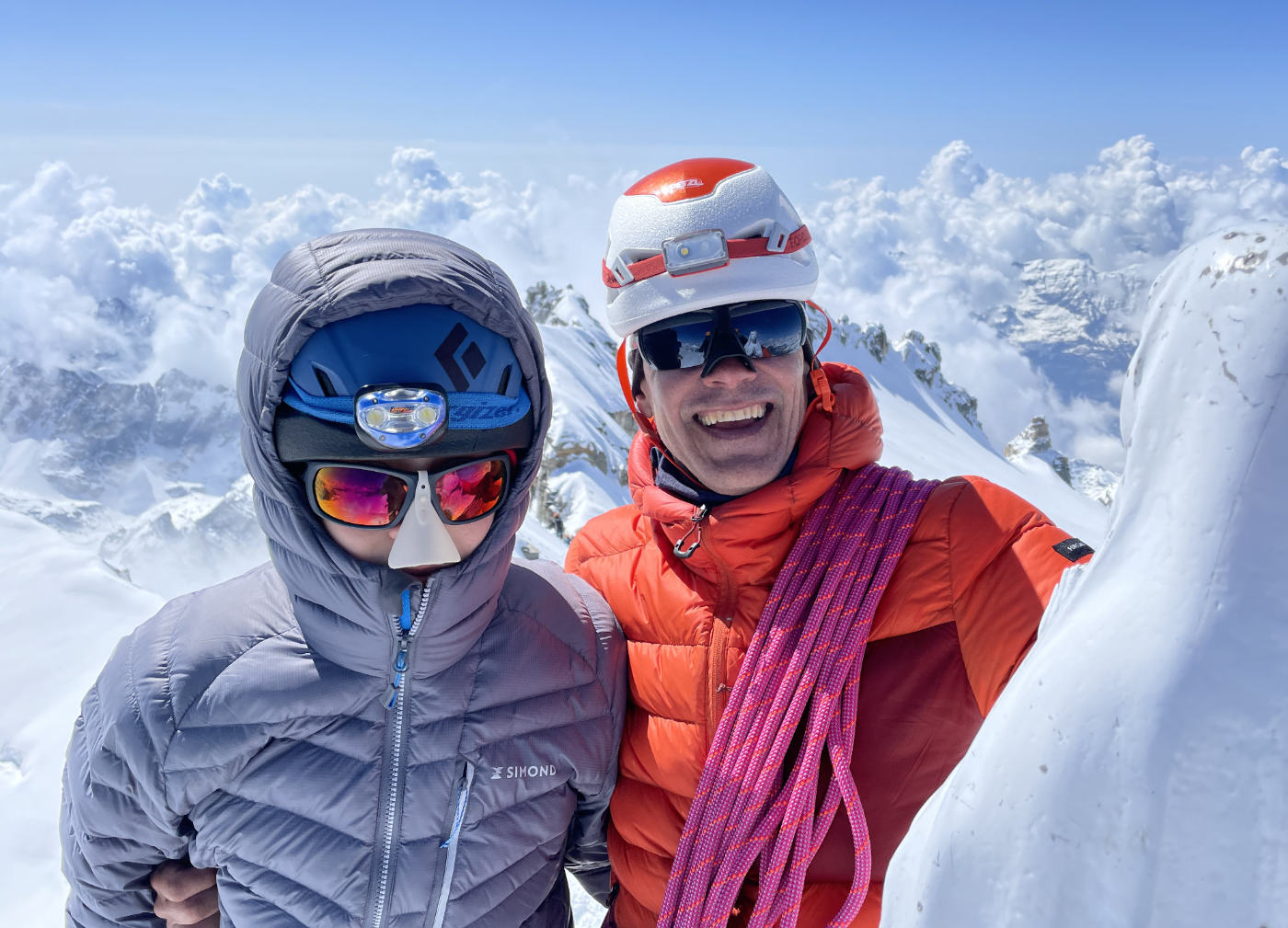

3,300 meters, an ice ridge in the Mont Blanc massif, no secure footing. Tobias Steinberger’s insulin pump has come loose, and the insulin in the spare syringe has frozen. No one plans for moments like this. Yet Tobias plans for them anyway, every single time, just in case.
Together with his son Tim, he is climbing all 82 four-thousand-meter peaks in the Alps—that is, every summit over 4,000 meters. Tobias lives with type 1 diabetes, an autoimmune disease in which the body no longer produces its own insulin. As far as the two of them know, he would be the first person with type 1 diabetes to achieve this, and Tim one of the youngest ever. We spoke with father and son about blood sugar at freezing altitudes, the toughest moments on the mountain, and what remains once the summit is long behind them.
From the First Summit to the 82-Peaks Project
How did your mountaineering story begin, and when did your hobby turn into the idea of actually climbing all 82 four-thousanders?
Tobias: “The mountains were never a conscious choice for us—they were just always there. When Tim was little, we started hiking, then came our first via ferratas, bouldering, and rock climbing. When I climbed Mont Blanc with my brother Simon, Tim saw that and wanted to come along too. I couldn’t very well say no, but the condition was that we had to be well prepared. So at age 13, after climbing 2,500 meters through the Höllental, Tim stood on the summit of the Zugspitze, grinning and proud of his achievement. He didn’t say much, but I understood: He’s drawn to the mountains, just like me.
We then climbed our first four-thousander together—the Breithorn in Zermatt—on a day when we were almost alone there and got to break trail ourselves. That’s how it all started. Not as a plan, more as a feeling: This is it. Then we pulled out the UIAA list—82 peaks—and Tim asked if we could climb them all. I thought for a moment and said, “Yes. Let’s do it.” Our hobby became a project the moment we stopped asking “if” and focused only on “when” and “how.”

You’re on this journey together as father and son. What does it mean to you to tackle this project together, and how does a goal like this change a father-son relationship?
Tobias: “It changes everything, but in a way I couldn’t have described before. On the mountain, there’s no more role-playing. I’m not just the father who knows best. We’re two people making a decision together that has consequences. When the weather takes a turn for the worse, when I need a moment because of my blood sugar, when Tim is tired but still wants to keep going—it all happens on equal footing. That forces a kind of honesty that doesn’t come so easily in everyday life. On the mountain, I get to know Tim in a way that would otherwise remain hidden from me—how he deals with stress, what drives him when things get tough, and just how incredibly strong he is, both mentally and physically.”
Tim: “For me, the most powerful thing is that we share these memories. Most people my age spend time with their dad on the couch or running errands. We stand together on peaks that other people never see in their entire lives. That creates a different kind of bond.”
Quick Explainer: Diabetes Terms
- Type 1 diabetes: an autoimmune disease in which the body no longer produces its own insulin. Insulin must be administered externally.
- CGM (sensor): continuously measures blood glucose levels and transmits the data to a pump or smartphone.
- Closed-loop (“loop”): The sensor and insulin pump work together to control insulin delivery largely automatically.
- Basal rate: the continuous supply of insulin. Bolus: an additional, targeted dose, such as before a meal.
- Ketoacidosis: a dangerous condition of blood acidification caused by severe insulin deficiency.
Diabetes Management at 4,000 Meters
Tobias, you live with type 1 diabetes yourself. What does your diabetes management look like on a high-altitude hike, and how is it different from your everyday routine?
Tobias: “In everyday life, Type 1 has a certain—albeit limited—predictability. You know how you react to meals, exercise, and stress. On the mountain, that routine goes out the window. More precisely: it still applies, but under conditions you can’t control. I use a closed-loop system: a Dexcom G7 sensor, an Omnipod pump, and Trio as the control software. The loop automatically regulates insulin delivery according to my settings, based on my sensor readings. I don’t have to constantly intervene manually.
For hikes, I have a fixed preset: 40 percent of my normal basal rate, with a target of 140 mg/dl. I activate this before I even set out. I eat breakfast as usual, but I only administer about 1 unit of bolus instead of the usual 4 to 5, and let the loop handle the rest. This might sound unusual to someone without a closed-loop system, but the system knows my pattern and continuously adjusts accordingly. What I always carry with me, though: several spare insulin cartridges and syringes as an absolute backup. Not because I don’t trust the system, but because up in the mountains, there’s no option you haven’t packed beforehand.”
Important: The settings described here—such as basal rate, target value, or bolus amount—are Tobias’s personal settings, agreed upon with his diabetes team for his hikes. They are not general advice and cannot be applied to others. Always discuss any changes to your treatment with your healthcare team.

Cold, altitude, and hours of exertion take their toll. How does this affect your blood sugar, and how do you prepare for it?
Tobias: “These are three forces pulling at the same time, sometimes in opposite directions. Cold can lower blood sugar because the body burns energy to stay warm. Altitude can raise it because stress hormones are released. The exertion itself lowers it, and the afterburn effect can keep it down for hours after the ride, as the muscles replenish their glycogen stores. You can’t really calculate it.
What I can do is ride with redundancy: spare cartridges, syringes, and fast-acting carbs within easy reach in my outer pocket, not deep inside my backpack where I’d have to search for them first. I carry the insulin cartridge right on my body in my pants pocket. Insulin mustn’t freeze—otherwise it’s useless—and you can’t tell that just by looking at it from the outside. The Loop takes a lot of the decision-making off my hands while I’m on the trail, but it’s not an autopilot that I trust blindly. I check the trend arrows regularly. If the arrow points down and we still have an hour to go to the summit, I act immediately—not only after I start feeling the symptoms.”
Was there a moment on the mountain when your blood sugar suddenly became an issue? How did you handle the situation, and which techniques and tools do you value the most?
Tobias: “Yes, on the Aiguilles Marbrées, a peak in the Mont Blanc massif. We were on an ice ridge at 3,300 meters—exposed terrain with no secure footholds. The pod—my pump—had come loose. The CGM was reading ‘high,’ and on a wall of ice and rock without working insulin, that’s no joke. I reached for the syringe, and then came the next problem: the insulin in the syringe had frozen when I tried to inject it. The needle was cold, and I couldn’t deliver the bolus. That’s exactly why I carry multiple syringes. I didn’t put on a new pod until I was back in the valley, when conditions allowed it.
What this taught me: Carrying insulin close to your body isn’t enough. The syringe itself also has to be warm when you need it. Sounds like a minor detail. But on the mountain, it makes all the difference. The tool I value most is the Trio System, because it frees up mental capacity for what really demands attention on the mountain. But what saved us on the Aiguilles above all was redundancy: three options and a clear plan that we’d discussed beforehand.
Another time, the situation was critical in a different way. My sensor was showing incorrect readings, while at the same time I felt unwell and dizzy—the same symptoms as altitude sickness. I didn’t know: Do I have altitude sickness, or do I have a massive spike in blood sugar? The blood test showed that my blood sugar was 200 mg/dl higher than what was displayed. In that situation, you’re heading toward ketoacidosis and can’t make sense of the symptoms. That was truly critical."
Record, Risk, and Turning Back
Your journey is also linked to a special record—being the first person with type 1 diabetes to climb all 82 four-thousanders. Does that drive you, and what’s more important to you in the end: the record or what you experience along the way?
Tobias: “As far as we know, no one with type 1 diabetes has ever fully completed all 82 four-thousand-meter peaks in the Alps. I’m doing this mainly because I have a blast. And we’ve received so much positive feedback—from people with diabetes and from young people who find courage in our project. That’s definitely worth the effort. Originally, we also thought Tim might be able to complete all 82 before his 18th birthday. That’s not going to happen, and I don’t care about it anymore. It would have been a nice milestone, but the project isn’t a race against the clock. Tim is 17, he climbs at a level that regularly impresses me, and we’re having amazing experiences. That’s enough.
What drives me every day isn’t the record. It’s the next summit photo with Tim. The record is secondary; the project is life. When we stand on the final summit, the record will be the topic of conversation for ten minutes. What remains are 82 dawns, a few crises from which we emerged stronger, and a son with whom I’ve shared something that no amount of money can buy."

Which tour has been the toughest for you so far, and which situation stands out most in your memory?
Tobias: “That was without a doubt the Matterhorn. We were on the move for 21 hours straight, without a break. We set out at four in the morning and didn’t get back until one in the morning. Even though it was August, we had winter-like conditions with fresh snow. And on the way back, I also had a flare-up of arthritis that spread throughout my whole body—every joint hurt. That made everything even longer and more arduous. But turning back wasn’t an option anymore; we’d already covered a third of the way back.
Our most dangerous moment was on Mont Blanc. We had to go through the so-called “Corridor of Death,” a gully where rocks are constantly falling. We were running a little late, and just two minutes after we passed through, a massive rock avalanche came down. If we’d been even a little bit slower, we would have been right in the middle of it.”
The high mountains don’t forgive mistakes. How do you tell when it’s getting too dangerous, and how do you decide to turn back?
Tobias: “When you start trying to convince yourself, it’s time to turn back. That quiet unease often sets in before there’s an obvious reason. Specifically: If conditions are worse than expected, we turn back. If my blood sugar isn’t stable and we’re still an hour from the summit, we turn back. If Tim or I reach our limit, we talk it over and decide together. No summit is worth endangering a rope team. What really helps: We discuss the criteria for turning back before the climb, not up on the mountain when adrenaline is running high. Just clarify in advance: What’s our turning point today, and what’s our turnaround time? This question saves lives.”
Gear, Cold, and Quick Energy
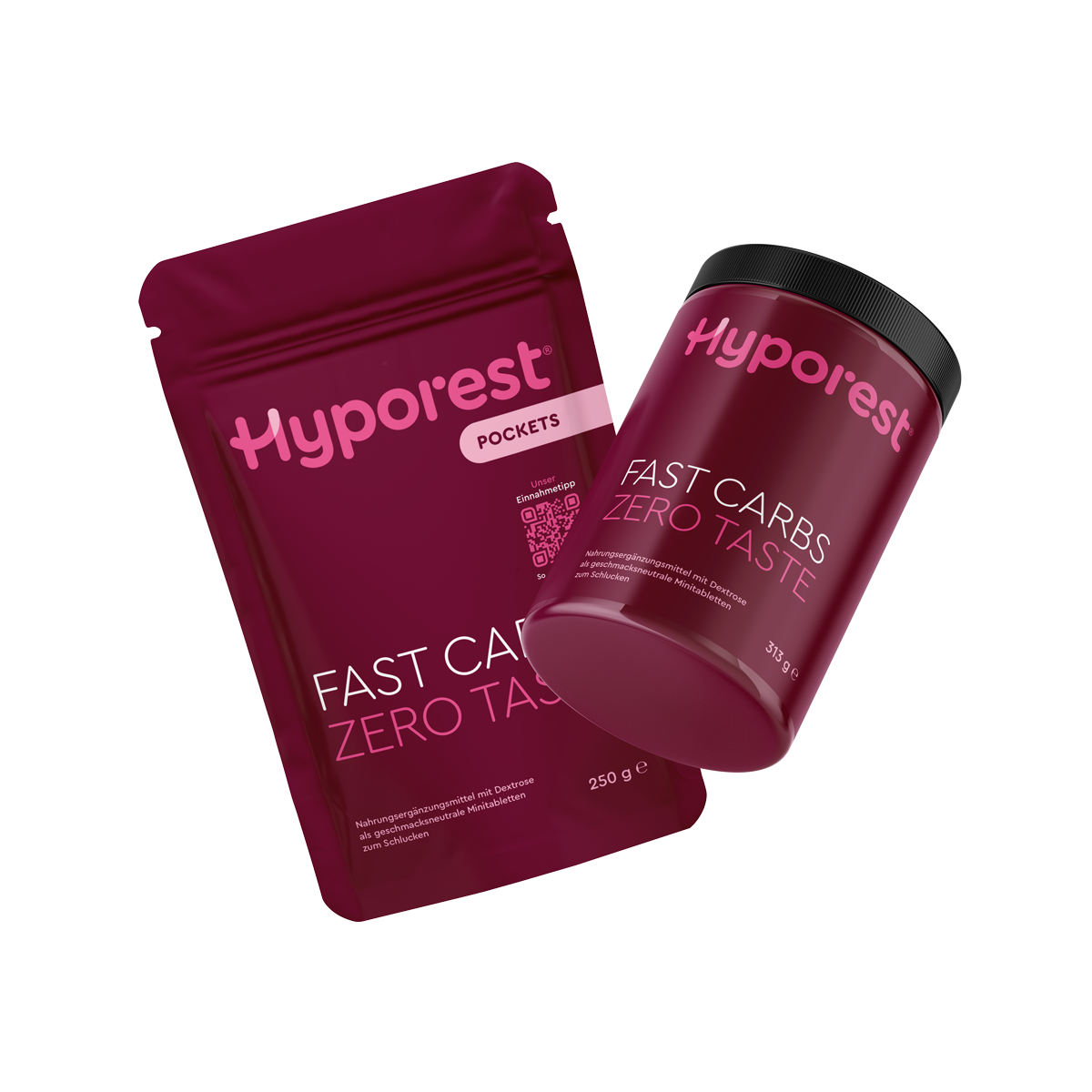
You carry Hyporest® for quick energy. What do you see as the advantage of this format, in which situations do you reach for it, and what does a product like this actually need to deliver on the mountain for it to be useful to you?
Tobias: “What a product needs to deliver on the mountain is actually clear: It has to work when I need it, not when I have the leisure to unwrap a bar. If I experience hypoglycemia on a steep slope, I might have one hand free, my motor skills are impaired, and I don’t have time for detours. Hyporest has a format that’s perfect for exactly that: compact, quickly accessible, with dextrose-and-blood-sugar">rapidly available carbohydrates. I reach for it at the first sign of a downward trend, not only once I’m already experiencing symptoms. At 3,500 meters, the gap between ‘I notice something’ and ‘I need help’ is smaller than in the valley.
What a mountain aid must do: It should be able to withstand the cold or be small enough to fit in my body pouch; it doesn’t need complicated packaging; and it provides fast-acting carbohydrates—no fats or proteins that slow down absorption. The fact that the mini-tablets are tasteless and, thanks to their coating, can be swallowed whole—so they barely come into contact with your teeth—is a real bonus for me."
Hyporest: What’s particularly important to you in terms of food and gear when it gets really cold?
Tobias: “Cold is the enemy of many plans. Insulin freezes. Batteries lose capacity. Gels get tough, and bars become rock-hard. The most important thing: Both Tim and I always keep a vial of insulin right on our bodies. It would freeze in the backpack at these temperatures. I also always carry a spare pump, test strips, and syringes in case of an emergency. And after the Aiguilles Marbrées, I know: the syringe itself has to be warm, not just the insulin inside it.
I don’t compromise when it comes to gloves. Anyone who’s had to confirm a sensor alert or change a cartridge with cold fingers knows why. I always carry a pair of thin inner gloves that I keep on for moments like that. And when it comes to eating: I eat before I get hungry. On the mountain, hunger often strikes too late—by then, the energy dip has already set in. Small glucose tablets have proven very handy for this. Another tip for managing the cold: “be bold, start cold.” I don’t bundle up at three in the morning; instead, I start every tour dressed almost a bit too lightly. Ten minutes later, when many others have to stop to take off a layer, my body is perfectly warmed up.”
What remains once the summit is conquered

Quick explanation: Mountaineering terminology
- Four-thousander: a peak over 4,000 meters. There are 82 of them in the Alps.
- High-altitude tour: a mountain tour in high-alpine terrain, often across glaciers and at high altitudes.
- Via ferrata: a climbing route on a rock face secured with steel cables and iron rungs.
- Elevation gain (Hm): the number of meters climbed during the ascent, not the distance traveled.
- Breaking trail: being the first to make a trail through untouched deep snow.
- (Ice) ridge: a narrow mountain ridge that drops steeply on both sides.
- Exposed: terrain with a significant drop below.
- Anchor point: a secured fixed point where the rope team anchors itself.
- Rope team: a group of mountaineers connected to one another by a rope.
- Mixed: terrain consisting of rock and ice that requires both climbing techniques simultaneously.
- Turnaround point and turnaround time: a predetermined location or time at which one turns back, no matter how close the summit is.
Tim, what appeals to you about the really big mountains? And what would you say to others your age who think such a goal is crazy?
Tim: “What appeals to me? The moment just before the summit. When your lungs are burning, your legs are heavy, and you still have a few meters to go. That moment when you know: I’m almost there, and I decide to keep going. I’ve never experienced that feeling anywhere else. And to others my age who think this is crazy: I get it. It is crazy. But almost everything worth doing sounds crazy at first. I was 13 when we started. Back then, I didn’t know if I could do it. I know now that I can do it because I’ve done it. You don’t have to want to climb all 82. But any goal that scares you a little bit is worth it. Because afterward, you know who you are.”
Reinhold Messner once said that his happiness was never at the summit, but only once he was back down in everyday life. What remains for you once a major goal has been achieved, and what drives you forward once all 82 peaks have been conquered?
Tobias: “Messner is right. At the summit, you’re exhausted, it’s cold, and your only thought is the descent. The happiness comes later. In the evening at the hut, when you hear Tim describe how he saw that difficult section. Or weeks later, when you see a photo and remember the wind. What remains? The way we talk to each other. What we know about each other. That Tim has learned to handle pressure—not through explanations, but through experience. And the many things I’ve learned from Tim—the wonderful things he’s persuaded me to do.
What comes after 82? We already have an idea. Because of my knee problems, we’ve started a paragliding course. The idea of simply flying from the summit down to the valley instead of hiking down for eight or ten hours is fantastic. That’s our next big project. And maybe that’s the real message: A condition that sometimes seems to limit life has taken us to 82 summits. And from there, into the air.”
Have a great trip, you two, and always make it back down safely!
In partnership with the 82 Peaks project. Tobias and Tim are equipped with Hyporest—the tasteless hyporest-pockets">mini Glucose tablets—on their hikes. You swallow them whole, so you don’t have to chew them even in sub-zero temperatures, whereas traditional glucose tablets become rock-hard and gels turn tough.
About the 82 Peaks Project
Tobias Steinberger and his 17-year-old son Tim are climbing all 82 four-thousand-meter peaks in the Alps together. Their journey is being covered by SWR Landesschau and Sat.1, among others, and is documented on 82-peaks.com as well as on Instagram at @82_peaks.
Medical Note: This article is for informational purposes only and is not a substitute for medical advice, diagnosis, or treatment. Diabetes management is individualized. Decisions regarding insulin, blood sugar, and equipment should be made in consultation with your healthcare team. Signs of severe hypoglycemia (confusion, loss of consciousness, seizures) constitute a medical emergency: immediately call 112 and administer prescribed glucagon. Hyporest is a dietary supplement, not a medication.